


Fashion Product Development: From Concept to Mass Production
In the fashion industry, the quality of a collection does not depend solely on creative design. The true value of a garment takes shape throughout the entire fashion product development process, a structured path that transforms a creative idea into a product ready for production.
From the initial design concept to industrial realization, each phase requires specific expertise: technical design, material selection, prototyping, testing and industrialization. This process is what enables brands to move from design to production, maintaining consistency between creative vision and manufacturing feasibility.
In today’s market—characterized by faster cycles and increasingly high-quality standards—product development has become one of the most strategic stages in the fashion supply chain. A mistake in the early phases can escalate during production, leading to additional costs or quality issues.
For this reason, many international brands and maisons choose to collaborate with specialized manufacturing partners. Structured environments such as a contract sartorial workshop allow design, pattern making and production to be integrated into a single technical workflow.
Product development therefore becomes a system: a balance between creativity, technical expertise and industrial organization.
Two Approaches to Product Development: In-House or With a Partner
When a brand starts developing a new collection, it can choose between two main models: managing the process internally or collaborating with an external manufacturing partner.
In the in-house model, the brand controls all phases of product development. The internal team handles design, pattern making, sampling and industrialization. This approach ensures full creative control, but also requires a highly structured technical organization.
Many emerging brands and established maisons, however, prefer to work with partners specialized in contract manufacturing. In this case, product development becomes a collaborative process between the brand’s creative team and the manufacturer’s technical structure.
The main advantage of this model is immediate access to advanced production expertise. Pattern makers, production technicians and industrialization specialists work together to transform the creative concept into a technically feasible garment.
Organized production structures, such as those described in our page on sartorial production, support brands throughout every phase of the process—from prototyping to final production.
This collaborative approach is now widely adopted in the luxury sector, where garment construction quality is a defining element of brand identity.
Selection of Materials and Components
One of the most delicate phases in product development is material selection. Fabric does not only define the aesthetic of a garment—it determines its behavior, durability and fit.
Within the fashion collection development process, materials are selected in close alignment with garment design. Fabric weight, weave, composition and finishing must all be consistent with the intended function of the product and the target season.
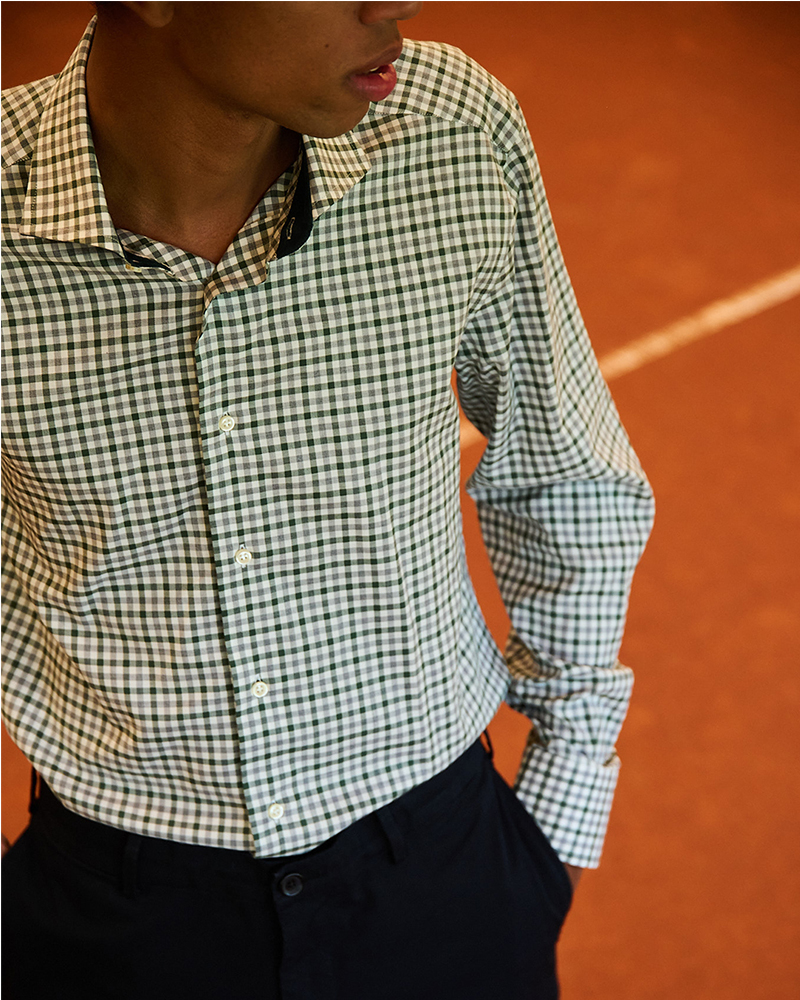
In shirtmaking, for example, fabric directly influences garment structure. Poplin, twill or Oxford can produce very different results in terms of comfort and visual appearance.
For this reason, material selection is often supported by technical testing and performance evaluation during processing stages. Further insights on this topic can be found in our guide to fabrics for contract shirt production.
In addition to the main fabric, product development also involves the selection of accessories and technical components: buttons, interlinings, internal reinforcements and finishing elements. Each component must be compatible with both the production process and the brand’s quality standards.
Consistency between materials and garment construction is what distinguishes standard industrial production from true artisanal-quality manufacturing.
Creating a Complete Tech Pack
One of the most essential tools in product development is the fashion tech pack. This is a technical document that gathers all the information required to produce a garment.
The tech pack represents the meeting point between creativity and production. It typically includes:
- technical drawings of the garment
- measurements and size charts
- material specifications
- stitching construction details
- finishing instructions
This document transforms a creative sketch into a detailed technical project. A well-structured tech pack reduces production errors and facilitates communication between designers and manufacturers.
Within the garment product development process, the tech pack becomes a coordination tool for all stakeholders: designers, pattern makers, production technicians and quality managers.
The quality of technical documentation directly impacts production stability. A clearly defined project reduces revision time, prevents errors and ensures consistency between the prototype and the final production run.
Prototyping and Fashion Sampling
Once the tech pack is defined, the process moves into the garment prototyping phase. At this stage, the design is transformed into a first physical prototype.
Prototyping allows for the evaluation of multiple aspects:
- fit and wearability
- proportions
- fabric behavior
- compatibility with the production process
Fashion sampling is therefore a phase of validation and refinement. Multiple iterations are often required before reaching the final version of the garment.
In recent years, many companies have integrated digital tools into this phase. Technologies such as 3D prototyping in fashion allow brands to simulate garment behavior before producing a physical sample.
These innovations help reduce development time and costs, while improving overall process accuracy.
However, prototyping remains a crucial phase—especially in the luxury segment—where every detail of garment construction must be carefully validated.
Industrialization and Pre-Production
Once the prototype is approved, the project enters the product industrialization phase. This step is essential to transform a sample garment into a product that can be replicated at scale.
During industrialization, all production variables are defined:
- sequence of operations
- production timing
- material optimization
- tolerance parameters
This phase requires continuous dialogue between pattern making and production teams. The goal is to maintain the quality of the prototype throughout mass production.
In structured environments, such as those described in our production process, industrialization is managed through control systems that ensure precision and consistency.
Industrialization is the moment when creative design meets manufacturing reality. Proper management of this phase reduces errors, improves efficiency and guarantees the final quality of the garment.
The Confezioni Gallia Approach to Contract Product Development
At Confezioni Gallia, fashion product development is conceived as a collaborative process with international brands and maisons.
Our approach integrates sartorial expertise with industrial organization, allowing us to support clients throughout every stage of the project—from pattern making and prototyping to final production.
Within our workshop, pattern makers and specialized technicians focus on the construction of shirts and high-end garments. Each project is developed in close collaboration with the brand’s creative team, balancing stylistic identity with production feasibility.
Our long-standing experience in contract manufacturing enables us to manage even the most complex collections, maintaining high-quality standards and meticulous attention to detail.
This approach is built on three fundamental principles:
- technical expertise
- production precision
- artisanal quality
Product development thus becomes a shared journey, where creativity and production work together to transform an idea into a garment capable of fully expressing the brand’s identity.