Cutting and garment construction for luxury apparel

The quality of a garment does not begin with the idea alone, nor with the fabric selection. It takes shape the moment the material is transformed.

Cutting and garment construction represent the critical transition between design and production, and it is precisely here that a project proves its technical solidity.

At Confezioni Gallia, cutting and garment construction are part of an integrated system, not an isolated department. Pattern making, marker planning, cutting, assembly and quality control operate in continuity. Each stage is connected to the previous one and prepares the next.

Within our tailoring workshop, fabric is never treated as a neutral material. Every fiber behaves differently, every weave has its own tension, every weight responds in a specific way to handling and construction. Understanding these variables is the first step toward ensuring precision in garment cutting and stability in luxury manufacturing.

Why cutting matters when working with premium fabrics

A premium fabric can lose much of its value if cutting is not carried out with method and precision. Over the years, Confezioni Gallia has developed strong expertise in precision fabric cutting, a capability that directly affects fit, proportions and garment durability.

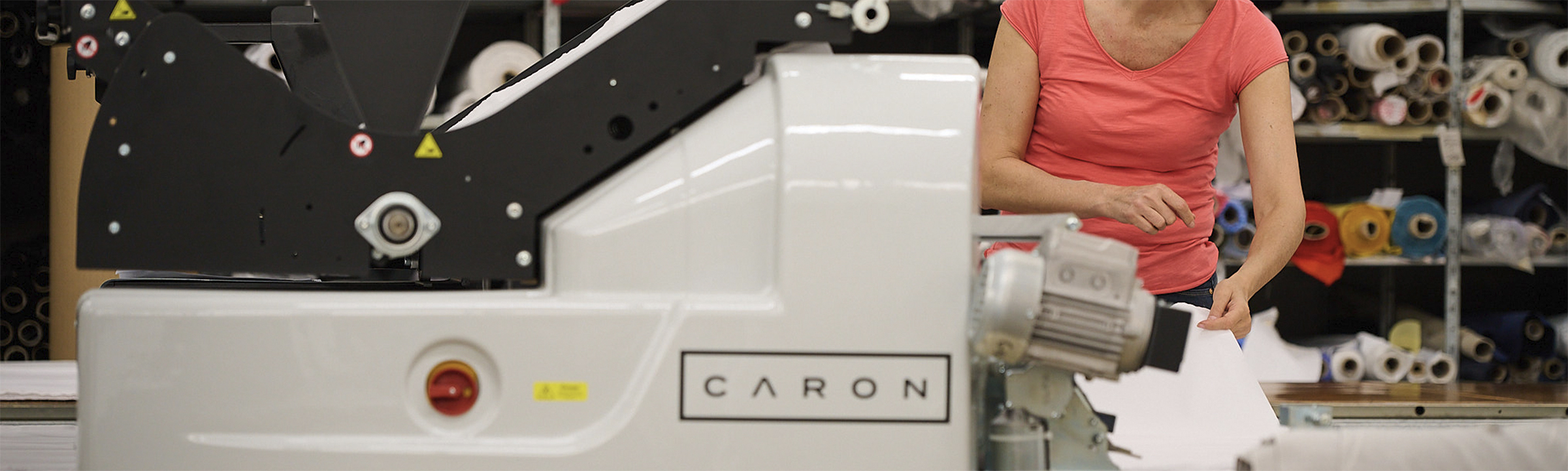
In industrial apparel cutting, every phase is planned according to the material. The fabric is inspected, allowed to rest when necessary, and evaluated in terms of stability and response to tension.

Marker planning is a strategic phase in high-end fabric cutting. It does not simply involve placing pattern pieces, but studying grain direction, orientation, pattern symmetry and tension management.

This is why cutting is fully integrated into our production process. It is not an isolated step, but a structural element of the system.

Marker planning and material optimization

Waste reduction begins with marker planning. Using CAD systems, we analyze the arrangement of pattern pieces while considering fabric height, technical margins, visible imperfections and pattern repeats.

Optimization is not a forced compression of the project. Through CAD tools, we evaluate marker layouts based on the actual fabric, accounting for roll height, grain direction, flaws and repeated motifs. Every millimeter saved affects not only the final cost of the garment, but also the sustainability of the process.

This attention is fully aligned with our vision of ethics and sustainability, where technical efficiency and environmental responsibility are part of the same production choice.

Managing complex fabrics and patterned materials

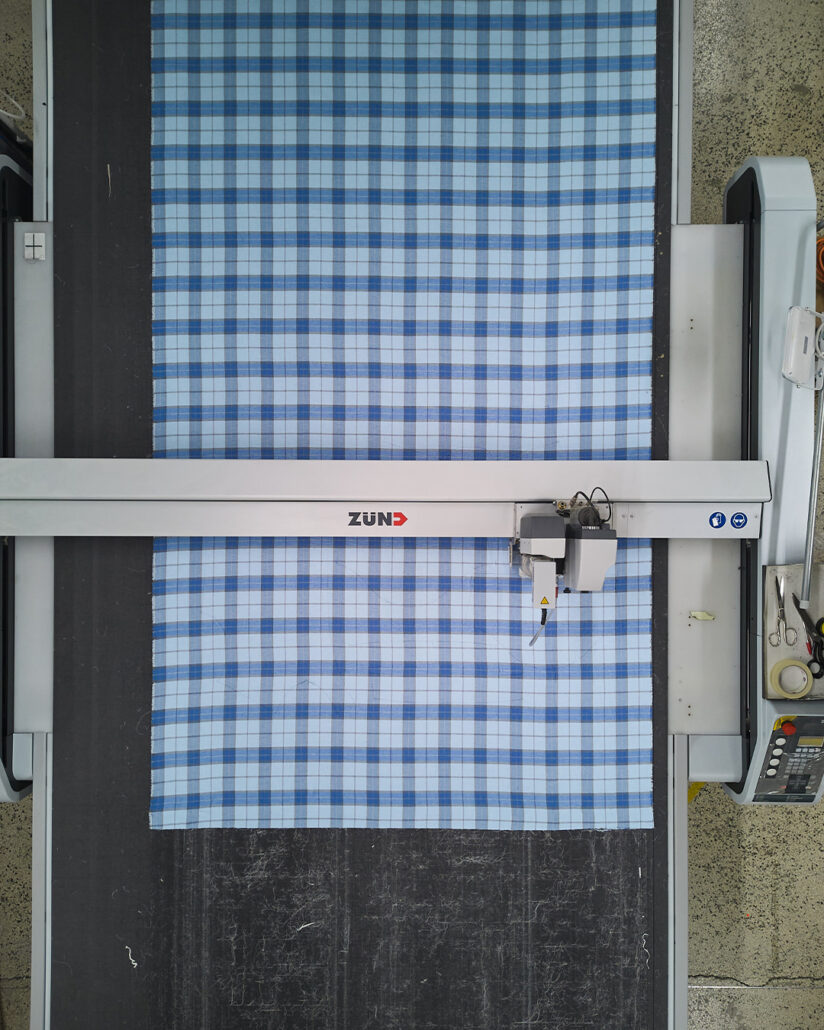
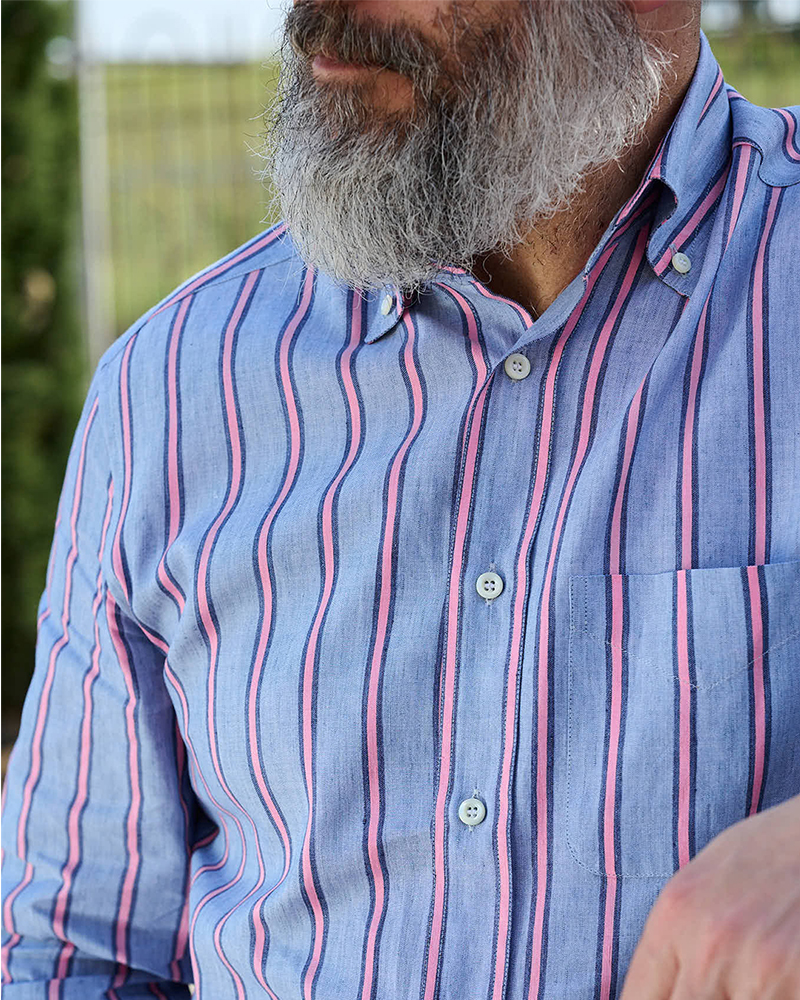
In luxury fabric cutting, complexity increases with stripes, checks and more structured weaves. The visual alignment between front panels, back sections and sleeves depends on cutting precision, not on garment assembly.

Lightweight or stretch fabrics require specific care. Dimensional stability must be tested before cutting begins. This is the only way to prevent the garment from losing proportion after pressing or washing.

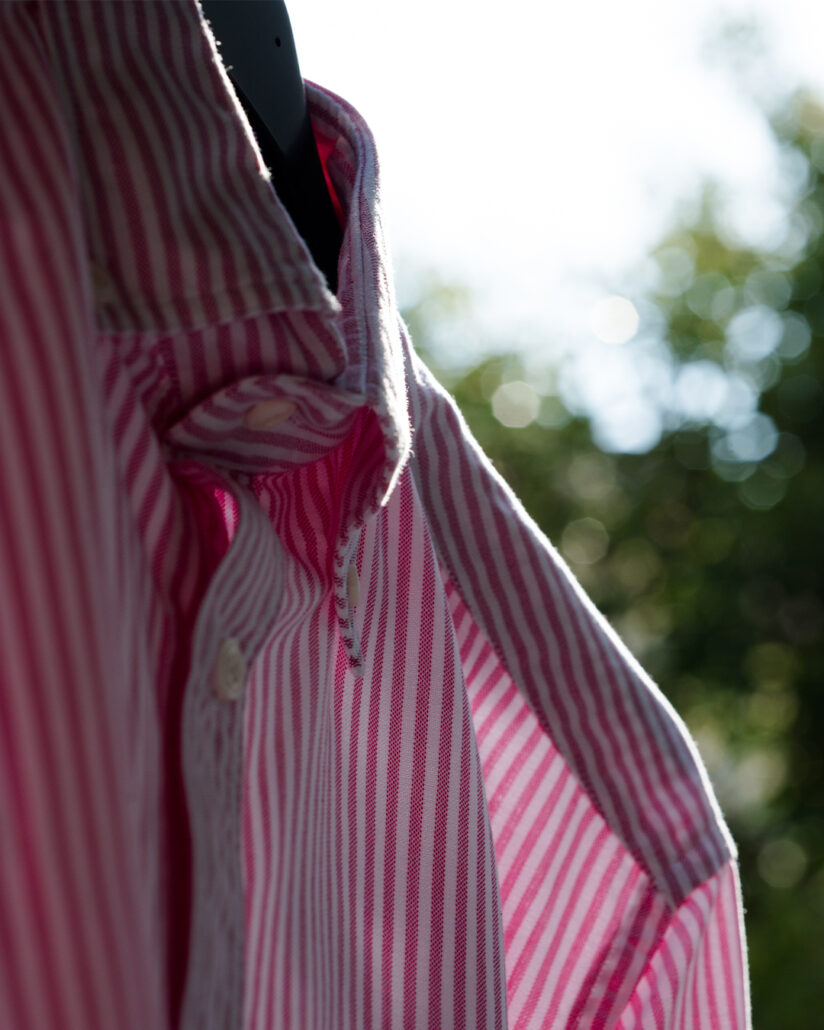
When working with directional patterns or continuous surface designs, cutting requires even deeper preliminary analysis. Visual continuity between front panels, yokes and sleeves is not just an aesthetic detail, but an immediate indicator of quality. Even a slight misalignment disrupts the harmony of the garment and compromises its perceived value.

With structured weaves or especially reactive fabrics, the three-dimensional behavior of the material is also assessed. Some fabrics slightly alter their internal tension once assembled. Anticipating this behavior during the cutting stage helps preserve proportions and long-term stability.

Working correctly with complex materials therefore requires the integration of technical control, sartorial sensitivity and the ability to anticipate how the garment will behave over time. This is a phase that requires method, not just experience.

CAD technology and CNC systems

CAD cutting makes it possible to simulate material consumption and pattern placement before physical execution. CNC systems ensure repeatability and consistency across ongoing production runs.

This integration is part of our vision of industrial efficiency, where technology and human supervision work together.

The use of CAD systems goes far beyond consumption simulation. It also allows us to analyze the interaction between pattern components, verifying joins, seam allowances and tolerances before the fabric is actually cut. This reduces the risk of rework and creates stronger coherence between design and production.

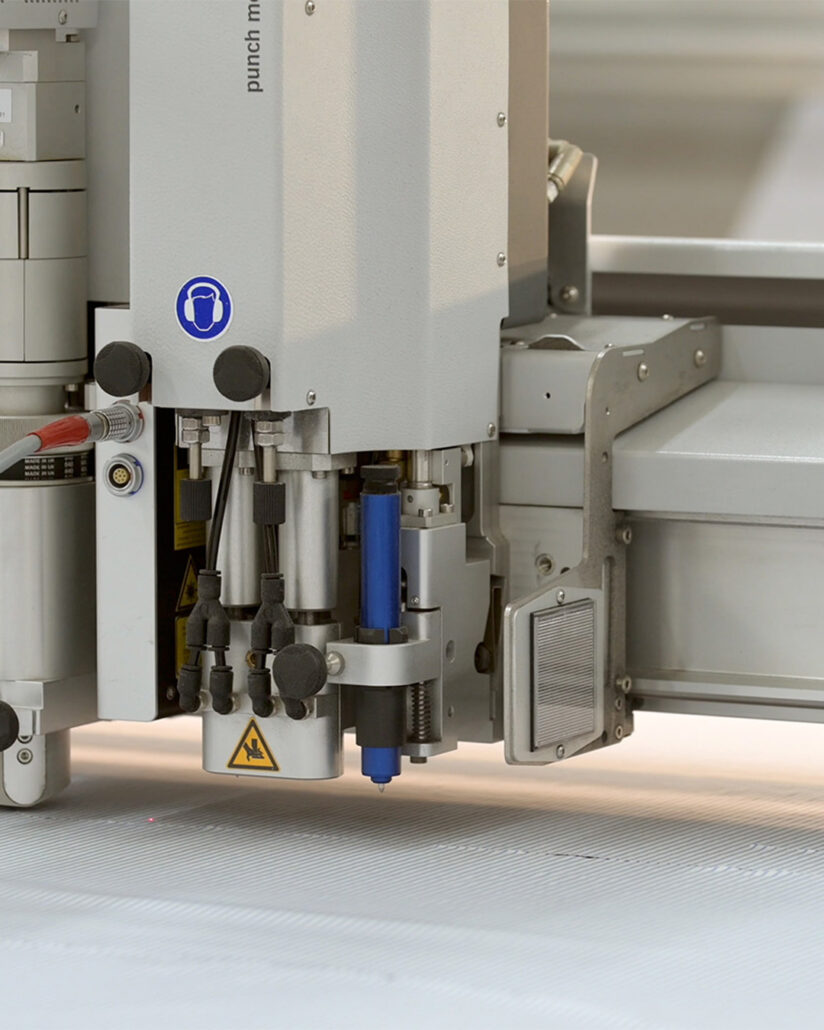
CNC systems, integrated with pattern-making software, ensure millimetric precision and consistent quality across medium to large production runs. Mechanical standardization does not replace human control; it strengthens it. Every cycle is supervised to ensure that technology fully respects project specifications.

In this balance between digital systems and manual expertise, an advanced production model takes shape—one that preserves sartorial quality even in structured industrial environments.

Grading, sizing and proportion control

In industrial garment cutting, size management is a critical stage. Grading is not simply mathematical scaling. It must preserve proportions, balance and the identity of the original model.

The dialogue with our sartorial production teams is constant. Pattern making and cutting work together to maintain dimensional coherence across the full size range.

Each size variation must preserve stylistic consistency and wearability. An error at this stage can easily be amplified across the entire production run.

In the luxury segment, consistency across sizes is part of the product identity. A shirt or structured garment must maintain balance in length, width and volume from one size to another. Effective grading does not alter the design language of the garment—it preserves its architecture.

For this reason, dimensional checks are carried out on representative samples across the size range, analyzing critical points such as shoulders, armholes, chest measurements and overall lengths. The goal is not simply to match theoretical measurements, but to ensure a fit that remains coherent with the brand’s stylistic intent.

Accurate control at this stage prevents serial defects and contributes to the stability of the entire production.

From sampling to continuous production

Cutting requirements change depending on the stage of the project. During sampling, flexibility is the priority. In ongoing production, consistency and repeatability become central.

The connection with our tailoring workshop remains constant in order to guarantee continuity between prototype and production.

The transition from sample garment to production is one of the most delicate moments in the entire process. What works on a single prototype must be verified from a serial production perspective: processing times, material stability, tolerance margins and repeatability.

Before continuous production begins, final technical specifications are validated and any micro-adjustments that emerged during testing are incorporated. This step reduces the risk of discrepancies between the approved first sample and the following production batches.

Continuity between development and production is never automatic. It is the result of constant coordination between pattern making, cutting and assembly. And it is precisely this coherence that allows high standards to be maintained even as volumes increase.

The garment construction line

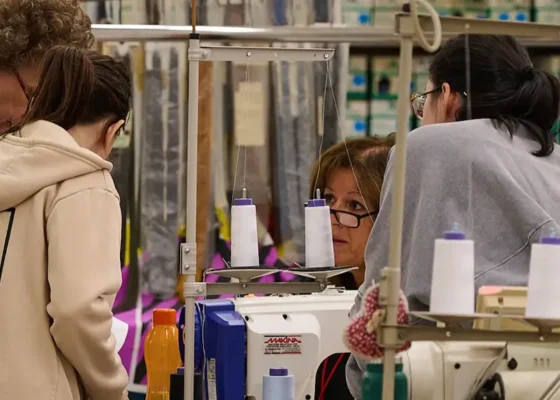
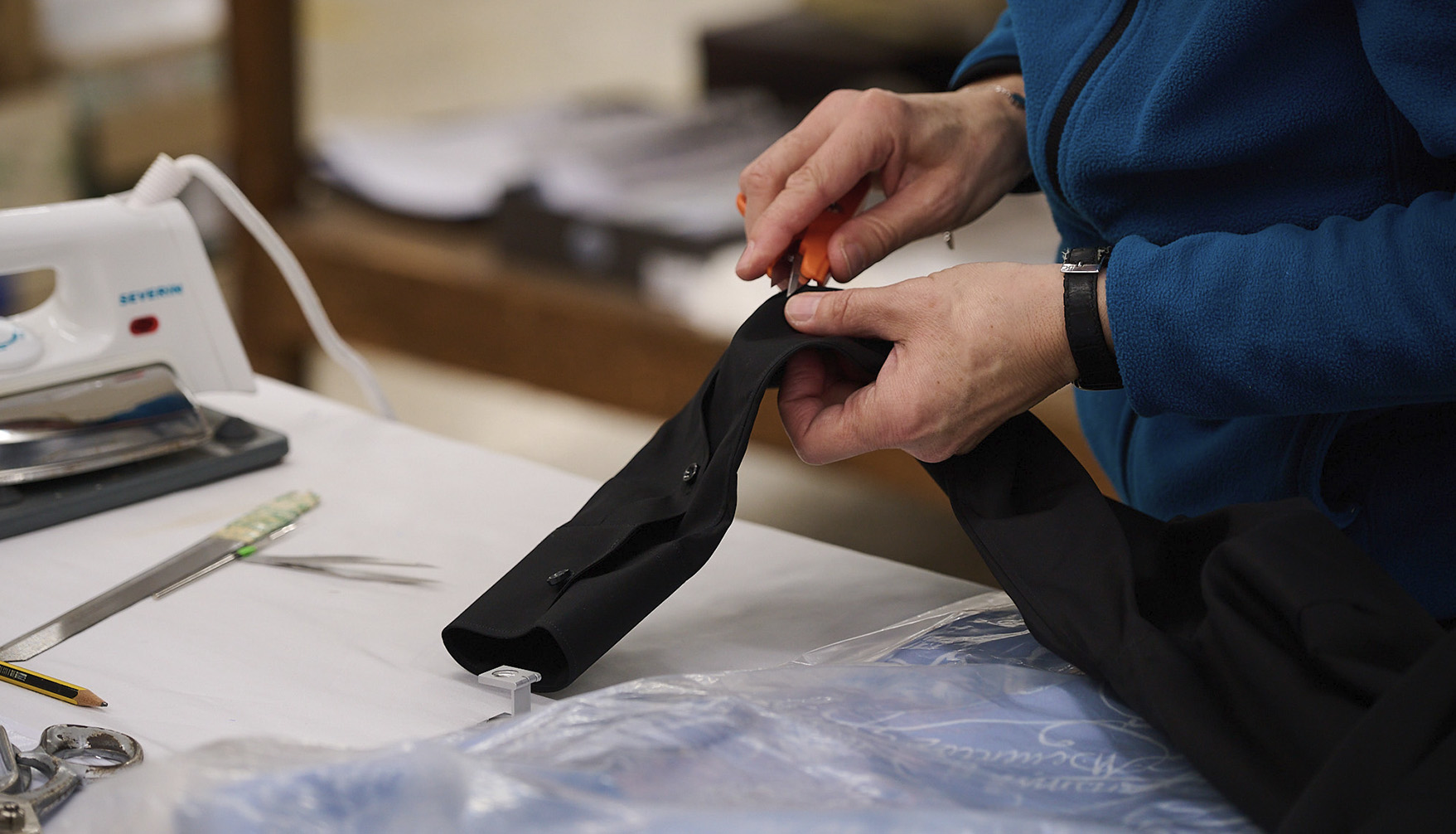
Garment construction is the stage in which the product takes its final form. In shirt manufacturing, the main phases include assembly, collar construction, sleeve insertion, topstitching and finishing.

Luxury construction techniques involve calibrated stitch density and invisible reinforcements.

In shirt construction, the sequence of operations matters. The order of execution directly affects the final result:

  • collar construction
  • insertion of internal interlinings
  • shoulder closure
  • sleeve insertion
  • topstitching
  • tension control

Each stage is calibrated according to the fabric. Luxury garment construction techniques are not standardized in a rigid way; they are adapted to the specific project.

Within our tailoring workshop, assembly is conceived as an architectural process rather than simple garment joining.

Multi-level quality control

Quality is not verified only at the end. It is monitored throughout the entire process.

During garment construction, checks are carried out on:

  • dimensional tolerances
  • stitching regularity
  • symmetry of components
  • consistency with the technical sheet

This system is an integral part of our production process.

Customization in third-party garment construction

In third-party garment construction, every brand defines construction standards that reflect its positioning. The objective is not simply to follow a technical sheet, but to interpret a precise production language made up of structural choices, proportions and internal coherence.

Customization may involve collar structure, stitch density, seam types, internal reinforcements, topstitching and hidden finishing details. These elements may not be immediately visible from the outside, but they strongly influence the overall perception of the garment, its stability and its recognizability.

In cutting and garment construction, every detail is calibrated according to the brand’s identity: a label oriented toward lightness will require softer structures, while a more structured positioning will favor solidity and definition. The difference is not merely aesthetic, but technical.

This approach transforms garment construction into a strategic tool capable of translating a creative concept into a coherent and repeatable product over time. In high-end third-party manufacturing, true customization is not decorative—it is structural.

Tolerances, controls and long-term stability

In luxury manufacturing, acceptable tolerance margins are minimal. Precision in garment cutting must be maintained within rigorous parameters.

During garment construction, intermediate checks are performed to verify:

  • seam alignment
  • critical measurements
  • stability of structural components

This multi-level system is an integral part of our production process, leaving no room for improvisation.

Cutting and garment construction as a strategic value

In luxury apparel, cutting and garment construction are not merely operational phases. They are the core of final product quality. This is where technical precision, proportion control and sartorial care are transformed into tangible value.

A methodical cutting process ensures stability and dimensional consistency. A well-structured construction process ensures durability, balance and recognizability. Every detail—from stitch density to internal construction—contributes to the garment’s solidity and its ability to maintain high standards over time.

In third-party garment construction, this means protecting the brand’s identity across the entire supply chain. In luxury, the difference is not visible only at first glance: it is perceived in the structure, the fit and the consistency between collection concept and final production.

Cutting and garment construction are therefore a strategic choice. When managed with method, they become a guarantee of Made in Italy quality.


Precision, method and control turn fabric into tangible value.
Let’s discuss your project and build a process worthy of your brand.

Blog

Storie, valori e materiali che rendono il Made in Italy un’eccellenza riconosciuta nel mondo